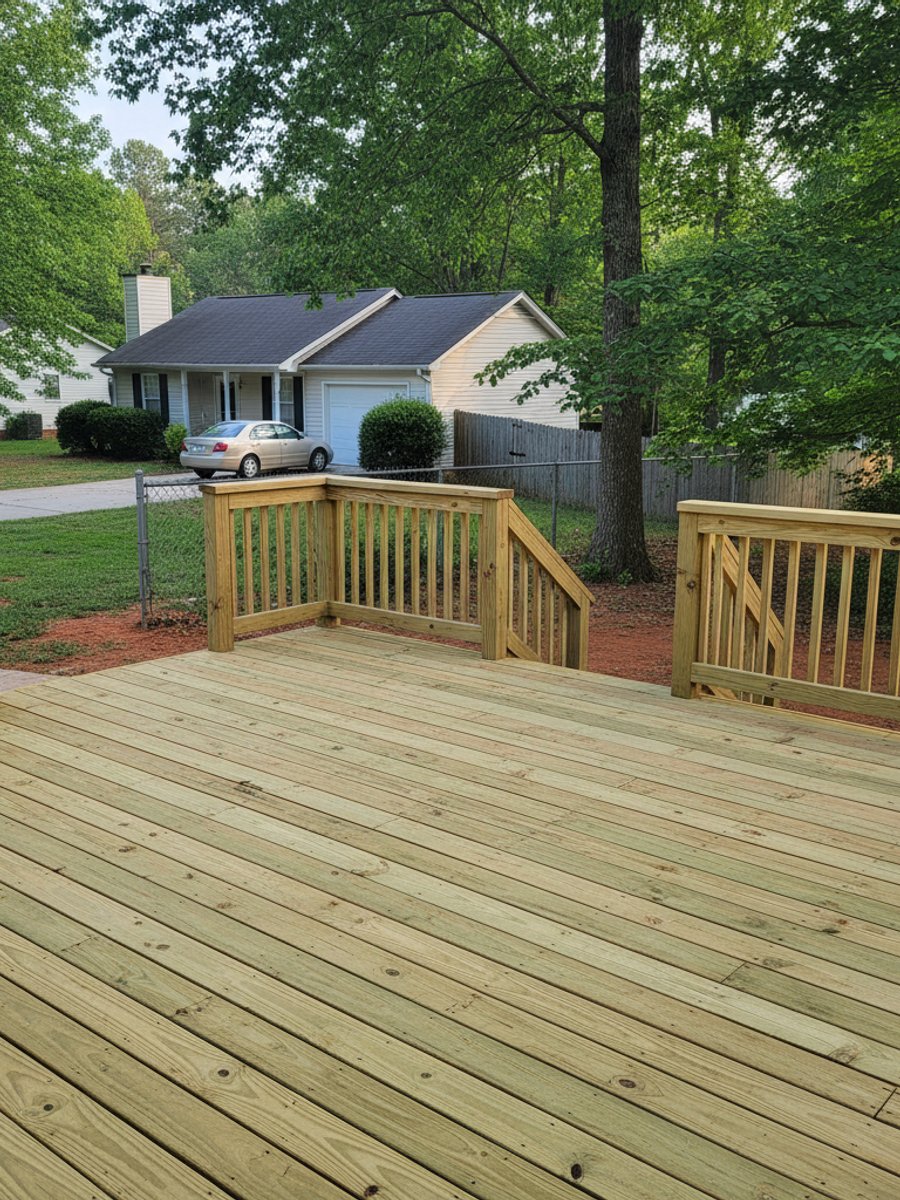
There are a lot of people in Paulding County who will call themselves a deck builder. Some of them have been framing for twenty years. Some of them bought a nail gun last spring. You can't always tell the difference from a business card or a Facebook page, so you have to know what questions actually separate the two.
This isn't a post about our company. It's about what to check before you hand anyone a deposit check for a project on your own house.
Start with the ground, not the deck
Dallas sits on red clay, and red clay does two things: it holds water when it's saturated and it shrinks hard when it dries out. A deck footing that's poured shallow, or worse, a deck that's just sitting on precast concrete pucks laid on top of the ground, will move with that clay over a few seasons. You'll see it as a slight lean, a gap opening up at the ledger, a post that's no longer plumb.
Georgia's residential code calls for footings below the frost line, which around here is about 12 inches, but a good builder isn't just hitting the minimum. For a single-level deck on 6x6 posts, footings are usually dug 24 inches or deeper and poured with a bell shape at the bottom so the clay can't heave them. Ask the builder how deep they dig and whether they pour or use pier blocks. If the answer is vague, that's your answer.
Ask about the ledger board before you ask about the railing
Most deck failures you read about, the ones that make the news, trace back to one spot: where the deck attaches to the house. That's the ledger board. It has to be lag-bolted or through-bolted into the rim joist, not nailed, and it needs flashing that sheds water away from the house framing behind it, not into it. A deck that's been up five years with a rotting ledger usually looks fine from the yard right up until it isn't.
Ask directly: how is the ledger attached, and what's the flashing detail? A builder who's done this for real will answer in one sentence without blinking. Joist hangers matter too. Toe-nailed joists work loose over time; galvanized or stainless hangers rated for exterior use don't.
Permits aren't optional, even for a simple deck
Paulding County requires a building permit for most attached decks, and for anything with a roof over it, like a screened porch, plan on a more involved review. The county inspects the footings before you're allowed to pour concrete over them, and again at framing before the boards go down. Skipping this step doesn't just risk a fine. It means nobody with any authority ever checked the part of the deck you can't see once it's built.
If you're in one of the newer subdivisions going up off the Nathan Dean Bypass or out toward Hiram, there's a decent chance you've also got an HOA with its own rules on setbacks, materials, or how close a deck can sit to the property line. Older homes closer to downtown Dallas usually don't have that layer, but they sometimes have older framing underneath that wasn't built to today's span tables, which changes what a builder can safely tie into. A contractor who pulls the permit themselves, rather than asking you to pull it, is generally the one who plans to build to code rather than around it.
Georgia weather is hard on lumber, so ask how they account for it
Summers here run hot and humid, June through August especially, with afternoon thunderstorms that show up almost daily some weeks. Pressure-treated lumber comes off the truck full of moisture, and it needs time to dry out, usually somewhere between four and eight weeks, before stain or sealant will actually take. A builder who wants to stain your new deck the week it's framed is selling you a coating that will peel by next summer.
Winters are mild but not nothing. We get freezing nights and the occasional ice event in January and February, enough freeze-thaw cycling to work at any joint that wasn't fastened properly. Composite decking handles the humidity better than wood, but it still needs proper joist spacing, usually 16 inches on center instead of 24, because composite boards flex more than a 2x6 in the summer heat. If a builder quotes composite decking at wood spacing to save material, that deck will feel spongy within a year.
What to look for, and what should send you elsewhere
- Ask for their license and general liability insurance, and actually call to confirm the insurance is active, not just look at a certificate.
- A real quote breaks out footings, framing lumber, decking material, and railing separately. A one-line total that just says "deck" tells you they haven't thought through the job yet.
- Walk away from anyone who wants full payment up front. A deposit for materials is normal. The full balance before a single post is set is not.
- Walk away from a bid that's dramatically lower than every other one you got. Someone's cutting corners on footing depth, hardware, or lumber grade to hit that number, and you won't find out which until it's your problem.
- A builder who talks through span tables, post spacing, and beam sizing without you having to ask has done this before. One who just says "we'll figure it out on site" is guessing.
- If you're adding a second level or a screened porch, ask specifically how the extra load changes the footing size. A multi-level deck isn't just a bigger version of a single-level one, the math on the posts and beams changes.
None of this is complicated once you know to ask it. Most homeowners just don't know which questions matter until something's already gone wrong. If you want a second opinion on a quote you've already got, or you're starting from scratch, take a look at our deck builder work around Dallas and the surrounding towns and we'll tell you straight what we'd do differently.